Exotic Trees
-
Lagerstroemia indica ‘Soir D’ete’ – Crepe Myrtle is a charming small deciduous tree with a vase-shaped form. During summer, its lime-green leaves create a fresh display, before turning to rich autumn shades of yellow and gold. At the same time, ruffled light-pink flowers cover the tree in abundance, producing a truly spectacular sight throughout the warmer months. In addition, its smooth, shiny bark adds year-round interest. This variety thrives best in moist, well-drained soil and full sun, which ensures maximum flower production. Moreover, it makes a beautiful feature in a sheltered small garden. Growing to approximately 4 x 3 metres, it can also be easily trimmed to suit your desired shape and size, offering both flexibility and elegance
-
- Description
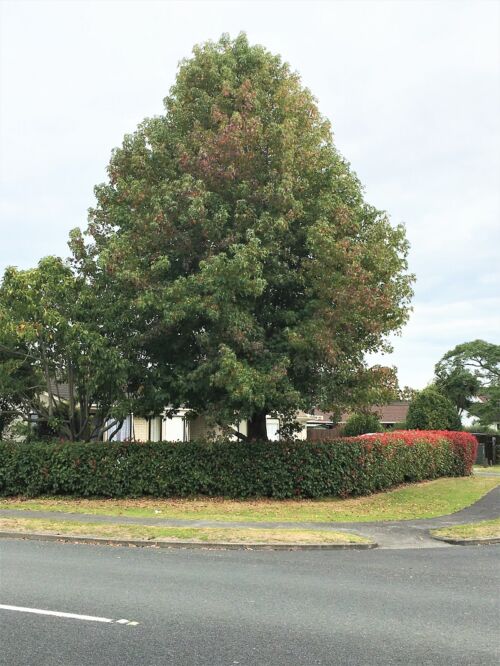
A magnificent, large, deciduous tree with a straight trunk and corky bark. Eventually forms a broadly conical crown. Narrow and erect when young, the tree develops an oblong to rounded crown at maturity. Green leaves over summer turn yellows, reds, purples and oranges in autumn. Height x Width 7 x 5 Height Range Medium 5-10m Growth Rate Fast Plant Type Tree Shape Round Country of Origin North America Similar to Consider Other Liquidambars, Acer rubrum types, Quercus coccinea or rubra, Pyrus spp. Amelanchier Canadensis, Nyssa Sylvatica - Leaf
Leaf Colour Green Deciduous Leaf Colour Orange. Yellow, Red, Green - Flower
Flower Nil - Uses
Specimen Yes Good Shade Tree? Yes Note: Growth, height and grade information are given in good faith but are subject to natural variables beyond our control. -
- Description
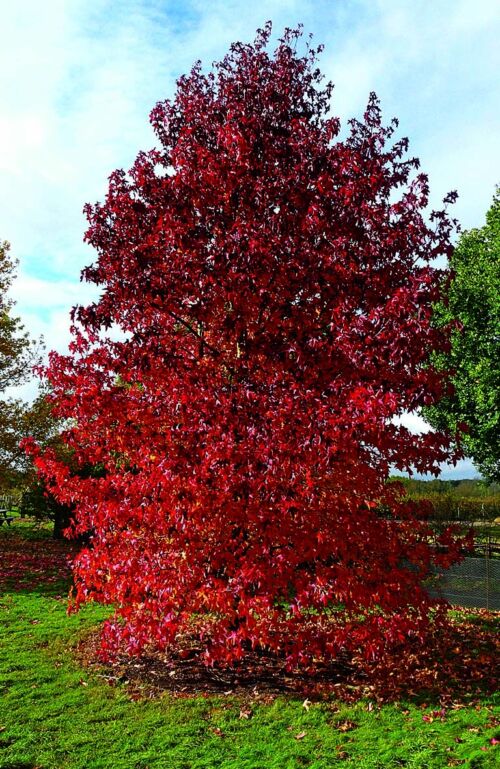
A pyramidal specimen tree with an upright broad growth habit. Green, star-shaped leaves over summer turn dark crimson during autumn. Makes a superb shade or specimen tree. Grows to apx 9 x 5m Height x Width 9 x 5m Range Medium 5-10m Growth Rate Fast Plant Type Tree Shape Pyramidical Country of Origin England Similar to Consider Other Liquidambars, Acer rubrum types, Quercus coccinea or rubra, Pyrus spp. Amelanchier Canadensis, Nyssa Sylvatica - Leaf
Leaf Colour Lush Green Deciduous Leaf Colour Crimson Red - Flower
Flower Nil - Uses
Specimen Yes Good Shade Tree? Yes Accent Yes Note: Growth, height and grade information are given in good faith but are subject to natural variables beyond our control. -
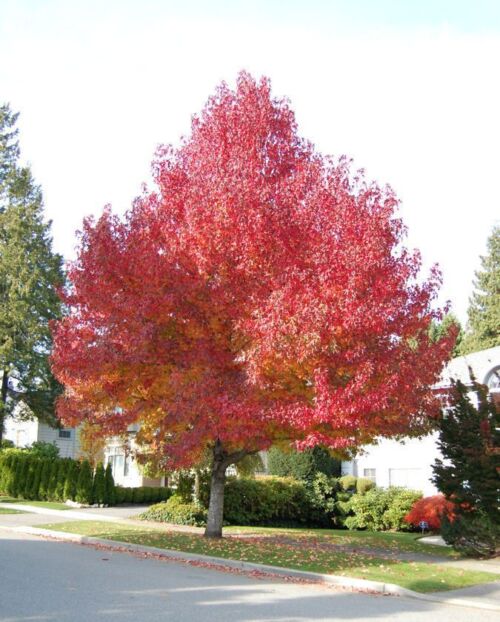
Sale!Liquidambar styraciflua 'Worplesdon' is a striking deciduous tree with an upright, pyramidal habit and distinctive corky bark. Its deeply lobed, green ‘maple-like’ leaves provide lush foliage throughout spring and summer. As autumn arrives, the leaves transform into a brilliant display of fiery red, orange, and yellow making it a true seasonal highlight. Thanks to its form and colour, this variety is excellent for avenue planting, as a shade tree specimen, or as a feature in small gardens. Ideally, it prefers a sheltered position with moist, well-drained soil conditions. At maturity, it typically reaches around 6 metres tall by 4 metres wide, offering structure without overwhelming the space. Interestingly, the Latin name styraciflua refers to its gum-producing nature.
- 6 x 4m
- Medium 5-10m
- Fast
- Tree
- Round
- North America/div>
- Other Liquidambars, Acer rubrum types, Quercus coccinea or rubra, Pyrus Aristocrat or Bradford. Amelanchier Canadensis, Nyssa Sylvatica, Liriodendron Tulipefera, Platanus Autumn Glory.
- Green
- Reds, Oranges and Yellows
- Moist well drained
- Prefers sheltered
-
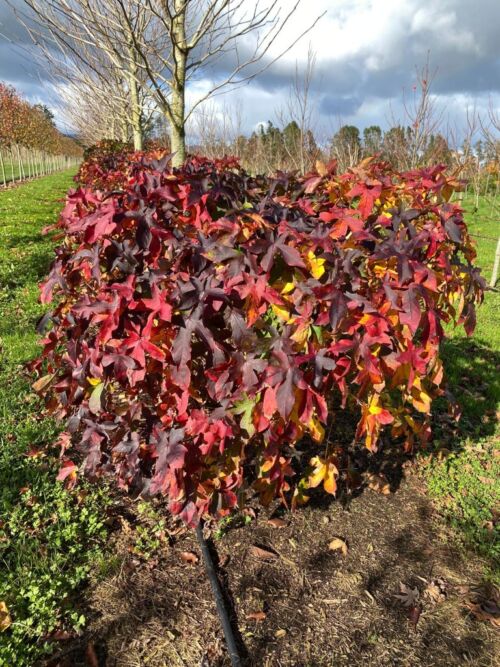
A dense rounded growth habit that can attain 3 x 2m. Lush green foliage in summer and spring followed by multiple colours of Purple, Orange, Red, Yellow foliage in autumn. Can also be grafted at a given height to produce topiary standards. Excellent lining paths or driveways. Perfect for smaller gardens.
-
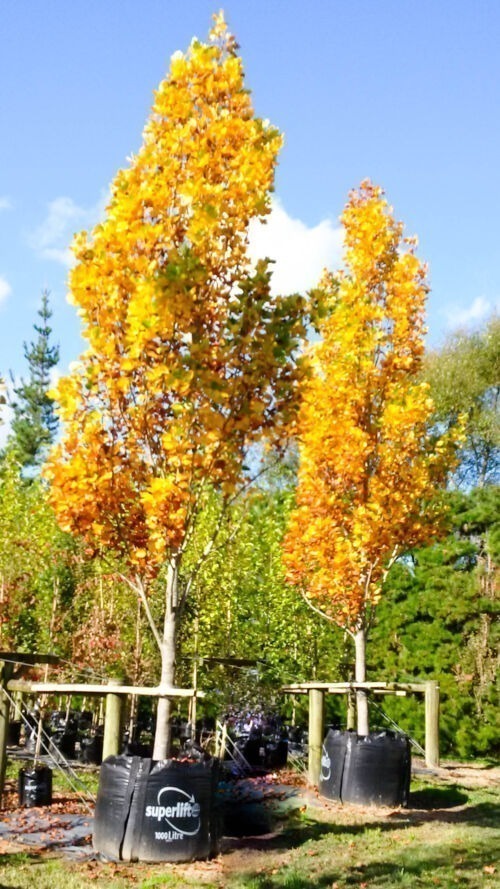
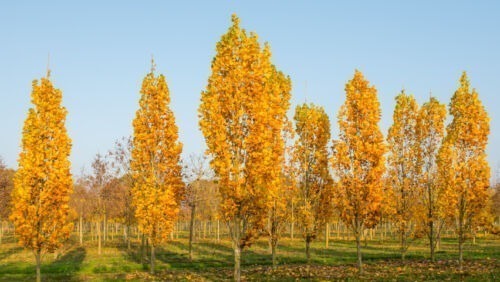
Liriodendron tulipifera ‘Arnold’ is a fast-growing, upright deciduous tree with a strong architectural presence making it perfect for narrow spaces. Its large, lobed green leaves stand out through summer, then transition to vibrant yellow in autumn, adding bold seasonal colour. From late spring into early summer, it produces striking tulip-shaped flowers in greenish-yellow tones with orange markings. These blooms enhance its ornamental value and contribute to its distinctive charm. Because of its tidy columnar habit and resilience, ‘Arnold’ suits formal landscapes and urban environments. It thrives in full sun and well-drained soil, offering a stately silhouette that elevates avenues, courtyards, and confined spaces. Typically reaching 15–20 metres in height, this cultivar originated from ‘Fastigiatum’ (Upright) specimens at the Arnold Arboretum in Massachusetts. Notably, it features a stronger central axis than other upright forms, making it a reliable choice for structured planting schemes.
-
- Description
A very upright form of liriodendron tulipifera with a columnar growth habit. Unusual, green lyre-shaped leaves turn butter yellow in autumn. Fragrant, tulip like flowers appear late spring which are a greenish yellow with an orange band at base. Adaptable to clay soil, though best suited to well-drained conditions to avoid excessive moisture. Height x Width 8 x 3 Height Range Medium 5-10m Growth Rate Fast Plant Type Tree Shape / Habit Upright Country of Origin North America Similar to Consider Quercus Robur Fastigiata, Carpinus betulus Fastigiata, Acer Bowhall, Platanus acerifolia pyramidalis. Betula var. Cupressus totem, Olea El Greco, Knightia Excelsa, Poplar crow’s nest, Ginkgo fastigiata. - Leaf
Leaf Colour Green Deciduous Leaf Colour Yellow - Flower
Flower Colour Green-Yellow Fragrant? No - Uses
Specimen Yes Small Garden Yes Note: Growth, height and grade information are given in good faith but are subject to natural variables beyond our control. -
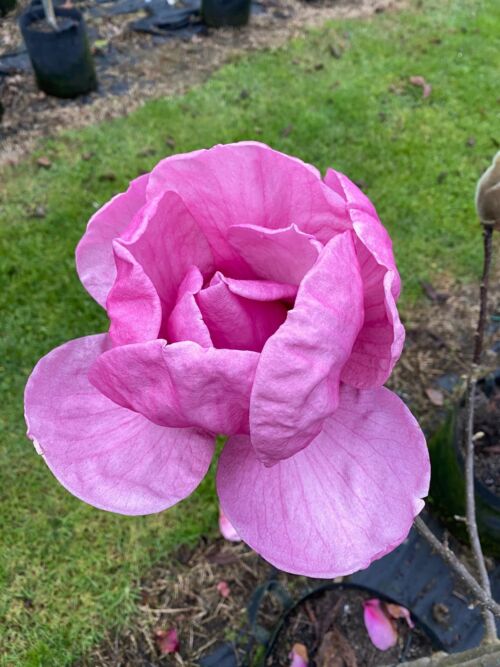
A smaller growing New Zealand bred tree with large leathery green leaves. Huge, deep magenta flowers late winter early spring make a spectacular sight before the tree comes into leaf. Upright branches, spreading habit. From the Jury hybrid series of Magnolias.
-
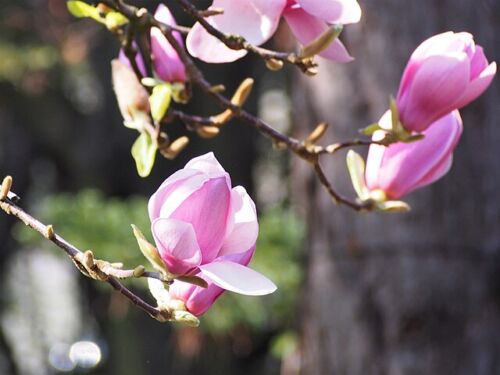
Magnolia ‘Iolanthe’ is a deciduous tree bred in New Zealand as part of the renowned Jury hybrid series. It develops into a large, rounded tree with an open branching habit, creating a graceful structure in the landscape. During summer, leathery green leaves form a lush canopy. From early spring, the tree bursts into masses of very large, lavender-pink, bowl-shaped flowers, delivering a spectacular seasonal display. It thrives in full sun and prefers moist, well-drained soil in a sheltered position. Growing to approximately 8 × 3.5 metres, it makes an excellent shade tree and a standout garden feature.
-
Yulan Magnolia - Magnolia denudata - is a moderately fast-growing tree with a rounded, dense canopy. Throughout summer, its large, dull green leaves provide lush coverage, gradually transforming into golden-yellow hues as autumn arrives. Then, in late winter to early spring, the tree bursts into bloom with pure white, goblet-shaped flowers that emit a delicate lemon scent. These blossoms appear on bare branches, creating a truly spectacular display. Originally from China, the name "Yulan" translates to "jade orchid" or "jade lily," symbolizing purity and elegance. Moreover, this tree prefers moist, well-drained soil in a sunny position, making it both resilient and easy to care for. Due to its smaller size, it is especially suitable as a feature tree in compact gardens or urban landscapes. Typically, it grows to approximately 5 metres tall and 3 metres wide.
-
Magnolia grandiflora ‘Little Gem’ is a compact evergreen tree originating from the USA. With its rounded form and slower growth, it provides year‑round structure and elegance in the garden. The glossy deep green leaves, highlighted by russet undersides, are typical of grandiflora magnolias. Moreover, creamy white flowers appear freely from an early age, filling the air with fragrance and charm. This magnolia tolerates clay soils; however, avoid overly wet conditions. In addition, it grows to approximately 5m tall by 3m wide but can be pruned easily to maintain shape and height. Because of its size and adaptability, ‘Little Gem’ is excellent for smaller gardens or large pots, offering beauty and versatility in both traditional and modern landscapes
-
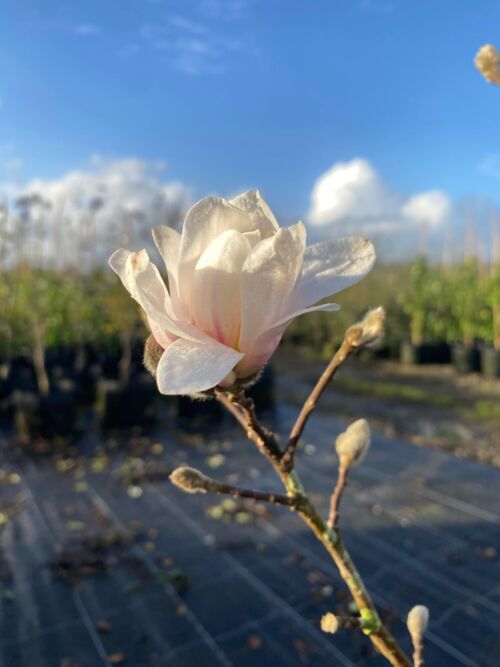
Magnolia stellata – Star Magnolia is a compact, deciduous shrub or small tree with a multi-branched form. In summer, lime-green leaves provide fresh colour, before turning yellow, bronze, or tan in autumn. Soft, fluffy buds open into star-shaped flowers, each with at least 12 delicate white petals. Blooming from late July, these long-lasting flowers add elegance and charm to the garden. Star Magnolia thrives in moist, well-drained soil and prefers full sun to partial shade in a sheltered position. It is ideal for smaller gardens, courtyards, or large pots, where it can be pruned to maintain shape and height. Typically, it grows to around 3.0 x 2.5 metres, making it a versatile choice for compact spaces.
-
A compact, multi branched shrub or small tree with lime green leaves turning golden in autumn. Soft fluffy buds open to flowers slightly larger than normal stellata and has more numerous long petals (sometimes to 36). They are also less floppy, resulting in a waterlily-like appearance (hence the cultivar name). Long lasting from apx late July. Ideal for the smaller garden.
-
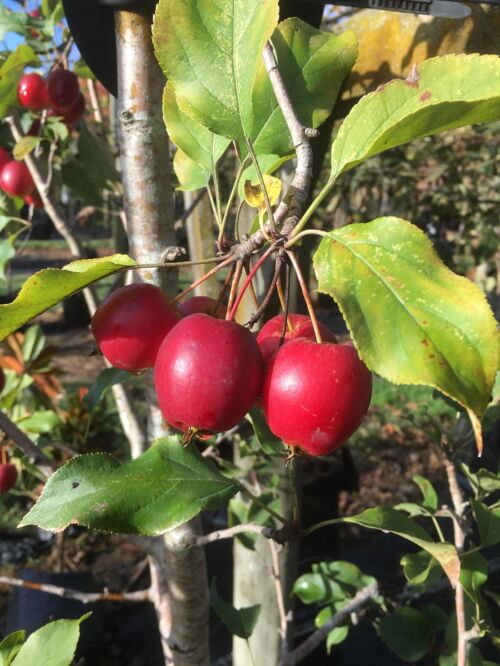
A strong growing smaller tree bearing masses of white tinged pink flowers from red buds in spring. In autumn clusters of large bright crimson fruit flushed orange and yellow. One of the best crab-apples for production of fruit suited for jelly’s and jams. Ideal for smaller gardens.
-
Malus floribunda, commonly known as the Japanese Crabapple, is a moderately fast-growing ornamental tree with its origins in Japan. With long, gracefully arching branches and small, dark green leaves, it brings elegance and seasonal interest to any garden. As spring arrives, the entire tree bursts into colour with bright pink buds that open into a profusion of small white to pale pink flowers. Shortly after flowering, yellow fruits flushed with red begin to appear. These fruits are not only edible but also attract birds, adding life and movement to the garden. Interestingly, the Latin name floribunda means “flowering freely” or “many-flowering,” perfectly describing this tree’s abundant spring display. Because of its compact size, reaching approximately 3 x 2.5 metres, it’s an excellent choice for smaller gardens, courtyards, or decorative planting schemes. Furthermore, it responds well to pruning, making it easy to maintain a neat and tidy shape.
-
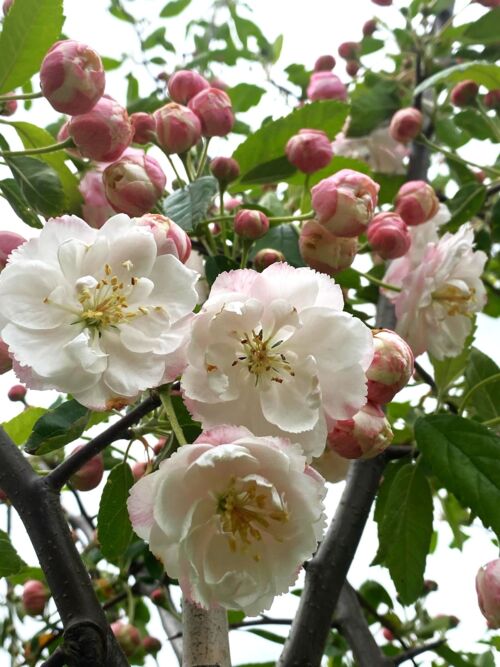
Malus ioensis 'Plena', also known as Bechtel’s Crabapple, is a compact, deciduous tree with a rounded, spreading form. Its bright green foliage creates a lush summer canopy. As the seasons shift, the leaves transform into a vibrant orange-red, adding a splash of autumn colour to your garden. In spring, this tree truly shines. It bursts into bloom with large, soft pink double flowers that are both fragrant and eye-catching. Although it produces a few yellow-green fruits, they are not edible. However, the real showstopper is undoubtedly the floral display. For best results, plant in a sunny, sheltered spot with moist, well-drained soil. Thanks to its modest size—reaching approximately 4 x 3 metres—it’s ideal for smaller gardens or limited spaces. Interestingly, Malus ioensis 'Plena' was discovered in the mid-1800s by E.A. Bechtel in the Illinois Prairies of the American Midwest. This origin also gives rise to its other common name: Prairie Crabapple.
-
Melia azedarach – Indian Bead Tree is a round-headed deciduous tree with glossy, compound green leaves. In spring, it produces scented pale lilac flowers. Later, during autumn, loose clusters of smooth oval berries appear, turning from green to bright yellow in winter. Not to be eaten. Tthe tree adapts well to a wide range of soils, provided they are well drained to prevent root rot. It grows best in full sun. Moreover, pruning helps open the crown and encourages the development of well-spaced limbs. Thanks to its dense leaf covering, it is ideal as a lawn specimen or shade tree. This hardy tree withstands frost, wind, and occasional dry periods. Finally, it reaches approximately 7m tall and 5m wide, making it a striking addition to any landscape.
-
Metasequoia glyptostroboides – Dawn Redwood is a fast-growing deciduous tree with a slender pyramidal to conical form. Its soft, fern-like leaves appear bright green in summer, before turning tawny-pink and gold in autumn, creating a striking seasonal display. As its name suggests, Metasequoia means “akin to Sequoia,” and the tree closely resembles the Californian Redwood. Originating in China, the Dawn Redwood thrives in temperate climates with full sun and consistently moist, well-drained soil. Highly adaptable and hardy, it grows well across a wide range of conditions, including varied soil types and urban pollution. Reaching approximately 12 x 5 metres in 10 years and maturing to 30 x 8 metres, it is best suited to parks and large open landscapes where it truly stands out.
-
Port Wine Magnolia - Michelia figo is a slow-growing, compact shrub that features a rounded shape and vibrant lime-green foliage. In early spring, it bursts into bloom with masses of small, cream-colored flowers streaked with purple, which release a rich fragrance. As a result, it becomes a standout feature in any garden. Depending on light conditions, the shrub’s form can vary. When grown in shade, it tends to develop a looser, more open structure. Conversely, plants grown in full sun are typically more compact and display denser foliage. Moreover, it thrives in humus-rich, well-drained, slightly acidic soil, making it adaptable to a range of garden environments. Whether planted in sun or shade, Port Wine Magnolia performs beautifully. It can be trimmed into a neat, low hedge, allowed to grow as a striking standalone specimen, or placed in a large decorative pot for added versatility. Originating from Western China, this elegant shrub typically reaches up to 3 metres tall and 2.5 metres wide.
-
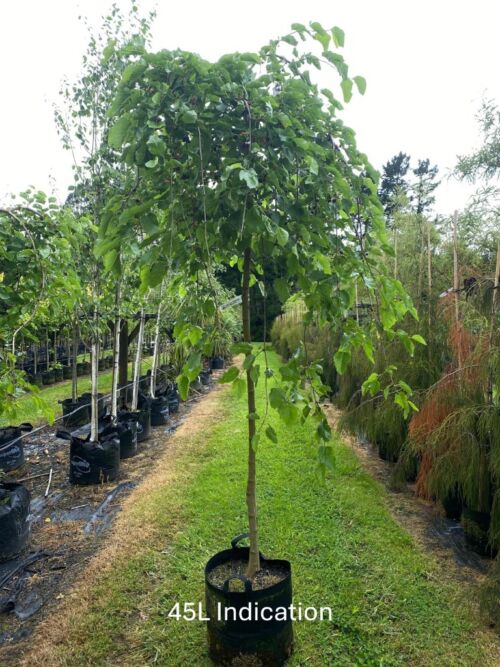
Morus alba ‘Pendula’ - Weeping White Mulberry, is a deciduous ornamental tree with a cascading, weeping form. Typically grafted onto a standard stem, its arching branches create an elegant silhouette that makes it a standout feature in smaller garden spaces. Throughout the growing season, this tree has large, glossy-green, leaves that shift to golden yellow in autumn, adding seasonal interest. In late spring, very small pale green flowers appear, followed by sweet, edible fruits. These fruits transition from greenish-white to rich pink or deep purple as they ripen—though you’ll need to be quick to get them, as birds are fond of them too. Moreover, this tree is self-fertile and easy to maintain. Height can vary depending on grafting, with our 2025 stock grafted on a clear stem at approximately 1.8 metres. Native to China, Pendula takes its name from the Latin word pendulus, meaning “hanging” or “weeping,” which perfectly describes its graceful form. Whether used as a focal point or tucked into a courtyard, Morus alba ‘Pendula’ brings charm, fruit, and structure to any garden.